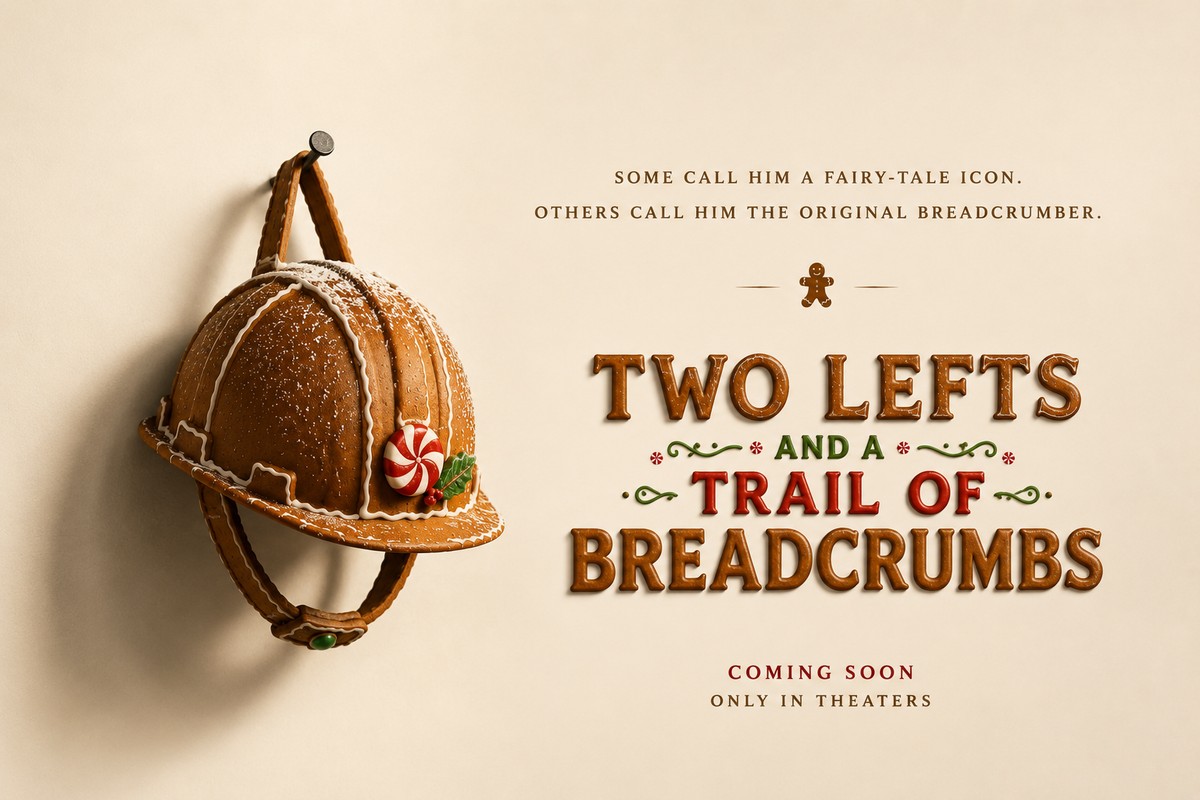
Awarded Best Family/Children Film at the June 2026 edition of the World Film Festival in Cannes, Two Lefts and a Trail of Breadcrumbs is a short film by American filmmaker Reagan Brock, blending traditional filmmaking with generative AI tools. This whimsical Christmas tale turns the Gingerbread Man into a handyman who runs from his emotions. Meet its director and writer.
Synopsis
SOME CALL HIM A FAIRY-TALE ICON.
OTHERS CALL HIM THE ORIGINAL BREADCRUMBER.
The Gingerbread Man has one rule: don’t stop moving.
So, when two kids accidentally tumble into his bizarre, candy-coated world after reading from an old storybook, he immediately does what he does best—panic, deflect, and pretend he absolutely does not care. But getting them home means surviving a city full of melting roads, popcorn sandstorms, aggressive gumdrop pigeons, and a suspiciously judgmental marshmallow council.
As the children drag him across a world he’s spent years running through, the Gingerbread Man starts realizing something horrifying: he might be becoming… emotionally available.
Two Lefts and a Trail of Breadcrumbs is a funny, heart-filled adventure about found family, fear of connection, and the world’s most emotionally avoidant cookie.
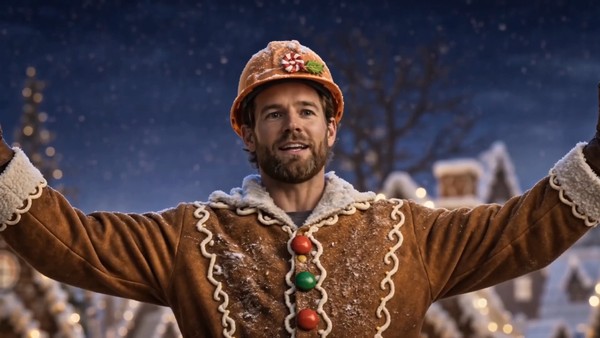
Reagan, in Two Lefts and a Trail of Breadcrumbs, you explore the emotional weight behind a classic fairy-tale icon. How did you conceive the idea of transforming the endlessly running Gingerbread Man into a working-class handyman in therapy, whose constant fixing and working is actually a mask for emotional avoidance?
The idea of transforming the Gingerbread Man into a handyman was inspired by my own blue-collar upbringing.
I grew up surrounded by men who were taught that being a man meant being strong, dependable, hardworking, and, above all, emotionally guarded. Vulnerability was often mistaken for weakness, and emotions were something you learned to suppress rather than express.
I witnessed this through my grandpa, my dad, my stepdad, and eventually in my marriage to a blue-collar man. These were men who worked incredibly hard and showed their love through what they could provide, build, or fix. But I also noticed a pattern: when emotions became too heavy or uncomfortable, they would turn to work. Being useful became a way to avoid being vulnerable. If something needed fixing, there was always a reason to keep moving.
Over the years, I’ve encouraged the men in my life to explore their emotions and question where their beliefs about masculinity originated. Were they living according to values they had consciously chosen, or were they carrying expectations passed down through generations without ever questioning them?
And slowly, I’ve watched some of those walls come down. I’ve witnessed moments of vulnerability, emotional honesty, and a willingness to question what strength is supposed to look like.
That’s where the Gingerbread Man became such a meaningful character to me. In the original story, he’s endlessly running, never stopping long enough to confront what’s chasing him. I began to see a parallel between his constant movement and the men I grew up around. What if his running wasn’t just about escaping something physically? What if he was running from himself?
Turning him into a handyman felt like a natural extension of that idea. He’s someone who knows how to fix everything around him but struggles to acknowledge what might need attention within himself. His work becomes both his identity and his escape.
And placing him in therapy creates an opportunity to explore what happens when someone who has spent their entire life doing is finally asked to simply feel.
Ultimately, I wanted to explore the idea that being needed isn’t the same as being emotionally known, and being strong doesn’t have to mean being silent.
For me, this character isn’t a criticism of blue-collar men. It’s an expression of love and curiosity toward the men who shaped my life, and an invitation to question the generational beliefs that have taught so many of them to carry their emotions alone.
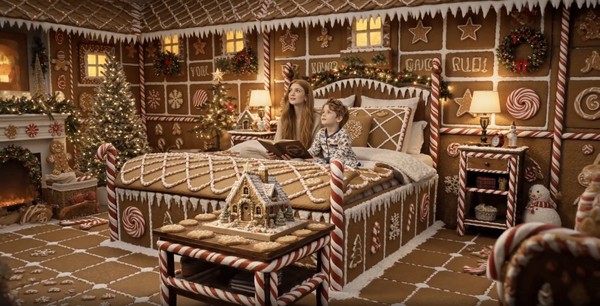
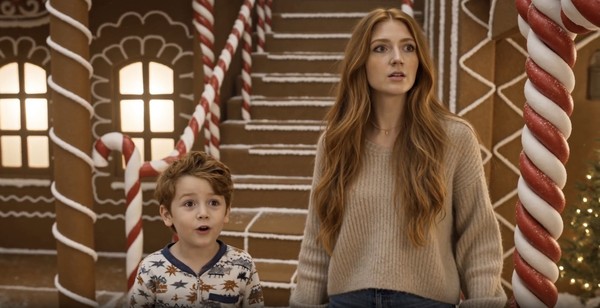
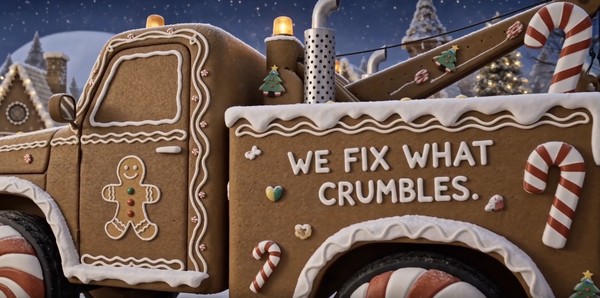
The visual world of Gingerbread Lane—with its popcorn mountains, candy forges, and chocolate waterfalls—evokes the magical, immersive wonder of Roald Dahl’s Willy Wonka. As a director blending traditional filmmaking with generative AI tools like Runway, Flow, and OpenAI, how did you craft this rich candy universe while maintaining a warm, tactile aesthetic?
The landscape actually began with a gingerbread house-building competition between my husband, our two kids, and me. We split into teams, with each child partnering with a parent, and gathered all kinds of sweets and treats to bring our creations to life.
My husband and I both have a bit of a competitive streak, so naturally, we weren’t going to stop at building just a gingerbread house. We wanted to create an entire world around it!
There’s a moment in the short film where the kids are building their gingerbread house and it crumbles. That scene was inspired by what happened to my son and me. I was so focused on making this incredible, elaborate structure that I completely overlooked the importance of a strong foundation. And, of course, it all came tumbling down.
We were pretty discouraged, but my husband stepped in to help us rebuild. Instead of keeping our houses separate, we decided to bring them together and create one little village. That unexpected moment became the inspiration for the entire candy landscape in the film.
From there, I used AI tools to expand on that memory, transforming our little handmade gingerbread village into a whimsical candy universe. I wanted to preserve the warmth, imperfections, and tactile quality of something made by hand while using AI to push the imagination further. The goal was to make it feel magical and larger than life, but still rooted in that cozy, nostalgic feeling of creating something together as a family.
The original soundtrack, generated with Suno AI, brings a classic holiday theatricality to the narrative. How did you direct the pacing and visual choreography of these musical sequences—such as “The Sweetest Street in Town”—so that the music served both the comedic storytelling and the emotional stakes of Graham’s journey?
I grew up singing in choir and performing in musical theatre, and I’ve been writing songs for as long as I can remember. Music has always been a huge part of my creative life, so when these AI tools became available, I immediately started thinking about how I could bring that love of musical storytelling into filmmaking.
With “The Sweetest Street in Town,” I wanted to create a moment that felt inspired by classic musical theatre while still being playful, whimsical, and connected to the original Gingerbread Man story. I loved the idea of taking this familiar fairy-tale character and reimagining him as the town’s beloved handyman, then using music to bring that world and his personality to life.
When it came to pacing and visual choreography, I approached the sequence almost as though I were staging a number for the theatre. I wanted the visuals to move with the rhythm of the music, with each moment building naturally into the next. It was really about finding that balance between storytelling, movement, and musical energy so the sequence felt like an organic part of the film rather than just a song inserted into it.
For me, it was a chance to combine two things I’ve always loved: musical theatre and visual storytelling, while using new technology to bring something I had imagined to life.
Midway through the spectacle, the film pauses for a quiet moment by the pretzel-stick fence where Leia asks Graham what he truly desires, setting up the moving reveal that he is writing to his future grandchildren. How did you balance the grand, whimsical adventure with these grounded, vulnerable beats of human connection?
Leia is named after my niece, who inspired the character. She never had the chance to meet my grandparents, whom my sisters and I still talk about frequently. Naturally, she’s created this romanticized idea of the man she never got to know. And I think that’s something we all do when we’re longing for an experience that other people had but we never got to have ourselves.
We romanticize the past. We imagine the love our grandparents experienced must have been grander, that people were somehow different back then. But the reality is that every human being is complicated, regardless of the time they lived in.
So, at the heart of this whimsical adventure, I wanted to explore what it might look like if my niece could actually meet this man she had placed so many projections onto. Throughout much of the film, Leia is almost unimpressed by Graham. She sees through his perceived confidence and recognizes his inability to be truly vulnerable. He isn’t the perfect, larger-than-life figure she may have imagined. He’s flawed, sometimes emotionally avoidant, and deeply human.
That’s why those quieter moments were so important to me. The spectacle and whimsy create this magical world, but the emotional vulnerability is what gives that world meaning. The moment by the pretzel-stick fence allows both characters to see each other a little more clearly, beyond the roles they’ve been playing.
And I think that’s really what the film is about. It’s not just a story about a man finding vulnerability and discovering his own path. It’s also about a young girl learning that people can exist in so many different versions, depending on who’s telling their story. Someone can be the town’s beloved handyman, an emotionally avoidant partner, a grandfather remembered with tremendous love, or a great-grandfather known only through the stories passed down about him.
All of those versions can be true at once.
I wanted Leia to discover that loving someone doesn’t mean they have to be perfect, and that sometimes understanding a person means making room for the parts of them that don’t fit the story we’ve created in our heads. To me, that’s where the real magic of the film lives. Not necessarily in the grand musical numbers or the fantastical world, but in those small moments when two people finally see each other as they really are.
In your Director’s Statement, you reflect on how two wrong turns can lead us back to the person we were always meant to be—a message echoed in your personal end-credit dedication to your grandparents. How much of your own perspective on family legacy and choosing one’s own path influenced the story’s emotional core?
So much of my perspective on choosing your own path comes directly from my own life. I’ve always said that I think children are actually the wise ones. It’s life that makes us forget that wisdom, and sometimes it takes growing old to realize we may have had it figured out from the very beginning.
I think about those small moments in childhood when we naturally gravitate toward the things that make us happy. For some, it’s nature. For others, it’s music, theatre, or art. Some children love taking care of baby dolls, others pretend to be doctors, and some spend every waking moment wanting to be around animals. Those little moments tell us so much about who we are before the world starts telling us who we’re supposed to be.
For me, it was always music, film, and theatre. Those were the things that made me feel most alive. But as I got older, I was encouraged to find a more realistic path. So I did what I think a lot of people do: I threw myself into corporate America and built this incredibly fast-paced life that, somewhere along the way, stopped feeling like my own.
And then, a few years ago, I reached a point where I just said, “No more.”
I started returning to all the things I had loved as a child: music, storytelling, filmmaking, and creating simply for the joy of creating. And what surprised me most was that it didn’t feel like I was discovering some new version of myself. It felt like I was finally recognizing someone I had known all along. I remember having this overwhelming feeling of, “There you are!”
And I think that’s really where the emotional core of this film comes from.
The idea is that sometimes we take what feels like a wrong turn, or even two, only to discover that those experiences were part of the journey back to ourselves. And that doesn’t necessarily mean the life we lived in between was a mistake. Sometimes we need those experiences to understand what matters to us.
My grandparents are such an important part of that perspective, too. There’s something incredibly powerful about the way people continue to shape us long after they’re gone: through the stories we tell, the love we remember, and the pieces of ourselves that we inherited from them. Their legacy reminds me that a meaningful life isn’t necessarily about following the path the world has laid out for you. It’s about the love you give, the things you create, and what you leave behind in other people.
I wanted Graham’s journey to reflect that: it’s never too late to rediscover yourself, to become more vulnerable, or to choose a different path.
And maybe the person we’re meant to become isn’t someone entirely new. Maybe it’s the person we were before we learned to be anyone else.
Congratulations on winning Best Family/Children Film at the World Film Festival in Cannes. As an independent creator pioneering generative digital cinema through Brockcast Media, how do you see this recognition shaping your future work, and what cinematic worlds are you eager to build next?
I think this recognition, along with the recognition the film has received since, has really reinforced my excitement about what these creative tools can make possible, especially for independent filmmakers.
For years, we’ve relied on written scripts, pitch decks, and PowerPoint presentations with a handful of visual references to communicate the worlds we’re imagining. And while those things are valuable, there’s always been this gap between what a filmmaker can see so clearly in their mind and what they’re actually able to show a potential investor.
I think generative tools have the potential to change that in a really exciting way.
As an independent filmmaker, I know firsthand how incredibly difficult it can be to secure funding. Sometimes the biggest challenge isn’t having a compelling story, but getting someone else to see the vision as clearly as you do. Now, we have the opportunity to bring those ideas to life visually before a production even begins. We can communicate tone, atmosphere, characters, and entire cinematic worlds in ways that previously required significant resources.
That’s where I see myself taking this technology next with Brockcast Media. I want to use these tools to push the boundaries of visual pitching and storytelling, and hopefully help bridge that gap between imagination and opportunity.
But I also want to be clear that I still deeply love traditional filmmaking. I love working with actors, collaborating with crews, and experiencing all the beautiful, unpredictable things that happen when people come together to make something. I don’t see these tools as a replacement for that. I see them as another way to bring more stories into the world, especially stories that might otherwise never get the chance to be told.
As for the cinematic worlds I want to build next, I’m most excited by stories that combine imaginative visuals with deeply human experiences. I love whimsy, nostalgia, music, and a little bit of magic, but I always want there to be something emotionally honest underneath it all.
Ultimately, I think the future I’m most excited about is one where technology expands what’s possible creatively, while we continue to keep human imagination, connection, and storytelling at the heart of filmmaking.
Because for me, the technology was never the story. It was simply another way to tell one.
BIO
Biography of Reagan Brock
Reagan Brock is an independent filmmaker, photographer, and visual storyteller focused on emotionally driven, visually cinematic stories. Her work blends traditional filmmaking with emerging AI tools to create immersive worlds grounded in human emotion and connection.
Director’s Statement
Two Lefts and a Trail of Breadcrumbs is about what happens when you realize you’ve been living a story that was written for you instead of one you chose for yourself. We follow expectations, careers, relationships, and versions of ourselves that often aren’t truly ours—until one day we realize we’ve been following someone else’s breadcrumbs.
Wrapped in a whimsical Christmas fantasy adventure, the story explores a deeply human question: Who were you before the world told you who to be?
Along the way, our greatest mistakes may become our greatest teachers. Sometimes, two wrong turns and a trail of breadcrumbs become the path to something greater. Because perhaps the greatest act of courage isn’t becoming someone new—it’s finding your way back to the person you were always meant to be.