


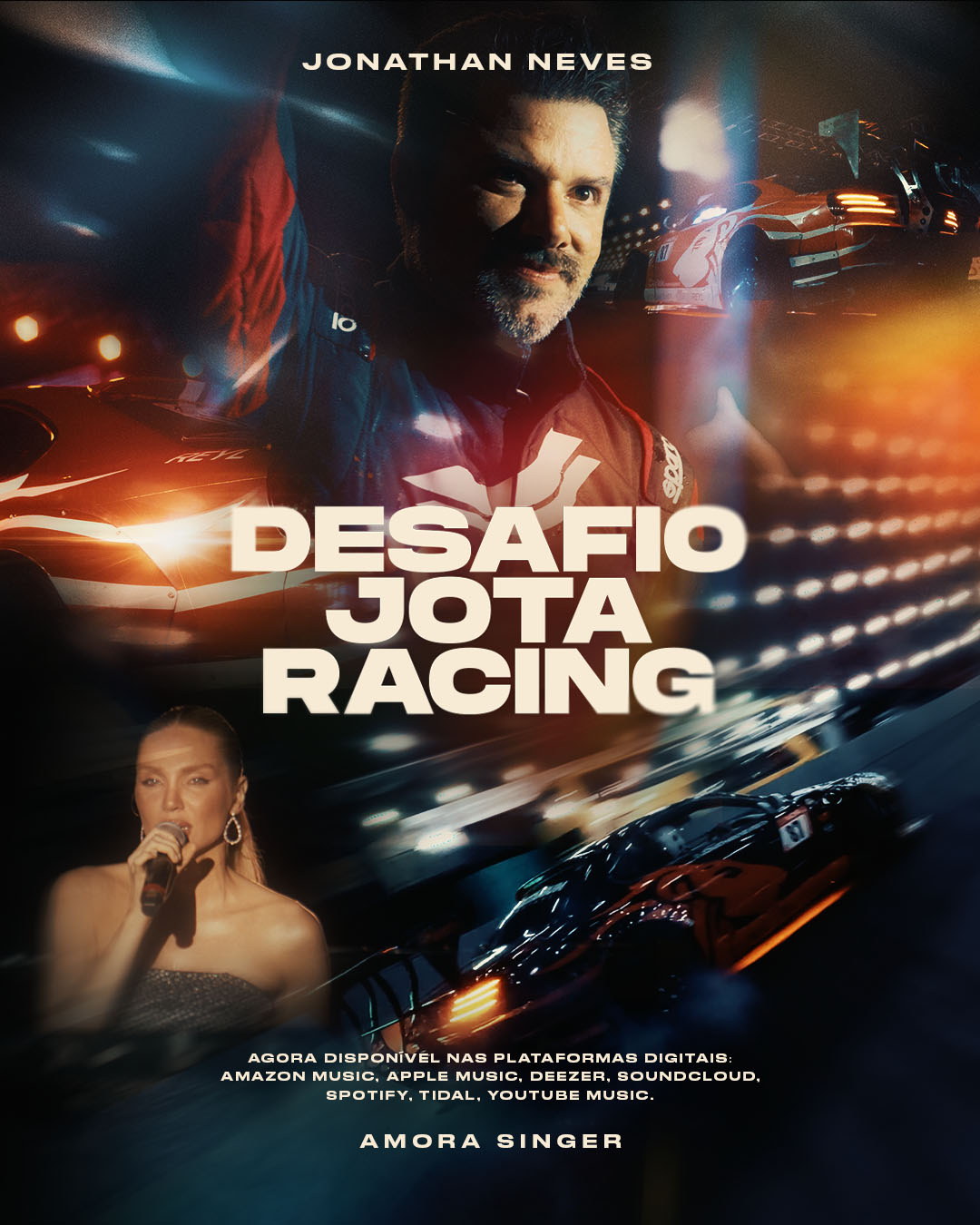
Awarded Best Sports Film at the World Film Festival in Cannes during the March 2026 edition, Jota Racing Challenge is credited to Jonathan Neves, Bruno Cassetari and Matheus Mathos Pio. The film turns a motorsport event into cinema: more than five hundred drones above a track, a drift car launched through the smoke, a singer at the centre of a boxing ring, stadium-scale pyrotechnics — all captured live, in a single take, with no room for error. A conversation with Jonathan Neves, director, executive producer and stunt driver on the film.
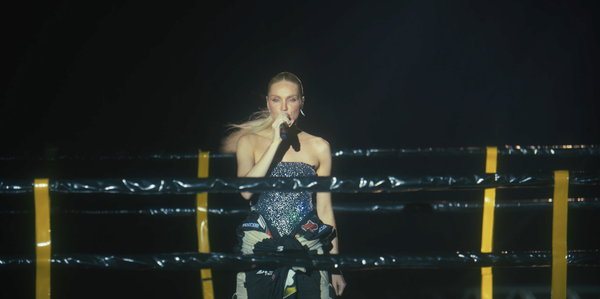
The presentation of the singer inside a boxing ring is a striking visual metaphor that immediately establishes a combative, almost gladiatorial tone. What was your creative vision behind uniting the aesthetic of a live concert, combat sports, and professional drifting into a single cinematic space?
From the very beginning I never wanted to create just a drift championship or a simple car event. My goal was to transform motorsport into an artistic experience, capable of moving even those who had never watched a race, attracting audiences of all types, ages, and genders — and that’s exactly what we achieved!
My idea was to do something that everyone would doubt the potential of, something people would say was impossible to do — to do everything outside the standard already set by big corporations and worldwide public taste, to create a truly unprecedented event, an open-air spectacle and not simply a race.
The ring symbolizes the battle every driver faces. Before competing against any opponent, he needs to overcome his own fears, insecurities, and limits. Music represents emotion, boxing represents the fight, and drifting represents freedom of expression through driving.
When we united these elements, we realized they all told exactly the same story: people who dedicated their lives to chasing a dream, even knowing how much sacrifice that journey demands.
The song’s lyrics suggest a deep connection between the driver, the machine, and the environment, encouraging us to “let the track find its own voice.” How was your collaboration with the musical artists to ensure the music didn’t just accompany the images, but truly narrated the emotional and physical experience of the sport?
I’ve always seen the music as a character in the film, not just as a soundtrack.
I wrote the lyrics myself, and over a period of three months I kept refining them — I wanted to transcribe all the sensations a driver has when getting into the car, closing the visor, and accelerating. I talked to myself a lot through the nights so that the lyrics would convey what a driver really feels when entering the track: a mixture of fear, adrenaline, concentration, freedom, and overcoming — something directly linked to the driver, like the marks they leave on the asphalt that aren’t necessarily just from tires, but from an entire history each driver carried to arrive at that moment. The lyrics also leave a message for the audience itself, a hidden message of faith: every person has a special calling meant only for them!
After that came bringing the artists together — singer Amora, very well-known in our region, and all the other instrumentalists chosen by hand, people purposely chosen from our city and region to value our state.
After that, the most fun part was in the studio, doing the collaboration with all the artists, listening to each one record their part of the score, sing, ask for adjustments, listen, listen again, re-record — we arrived at the studio at 8 a.m. and left at 3 a.m., with the song fully recorded and improved as I listened, suggesting small details like the initials DJR (Desafio Jota Racing) in Morse code, which, after all, are written with dots just like the music’s score. When I thought of that, we wrote it in Morse code and asked violinist Leo to play it and see how it would sound — a sound that turned out so good that we placed it in an isolated section of the song! An incredible day, which we actually have entirely recorded as a documentary on our channel!
In many moments it was precisely the music that guided not only the editing of the film created, but also the live event itself. The images began to breathe in the rhythm of the song, making every corner, every burst of smoke, and every acceleration feel like part of the same emotional narrative.
Our intention was for the audience not just to watch the drift, but to be able to feel what it’s like to be inside that car — and we succeeded, because in the end thousands of people cried, moved by what they saw!
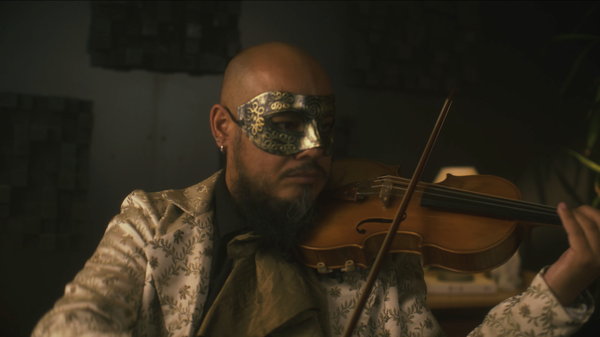
Filming high-speed motorsports at night is notoriously difficult. Still, the film’s cinematography is extremely atmospheric, using shadows, neon lighting, and pyrotechnic effects. Can you explain your visual strategy for lighting and framing, so that all that intense action conveyed a feeling that was both poetic and controlled?
Night was never a limitation for us; it was part of the visual identity we had imagined from the start, and I’ve always seen drift as a spectacle where anyone who sees it in person gets chills, that’s how exciting it is — but beyond that, I see it as excellent cinematic material.
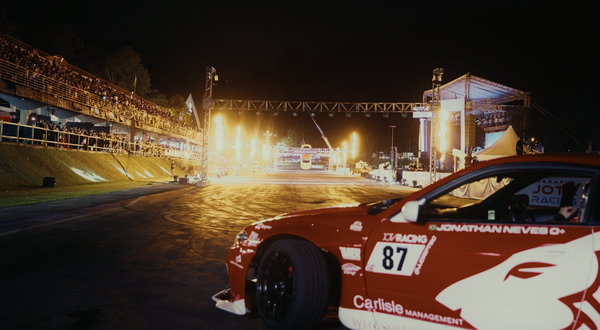
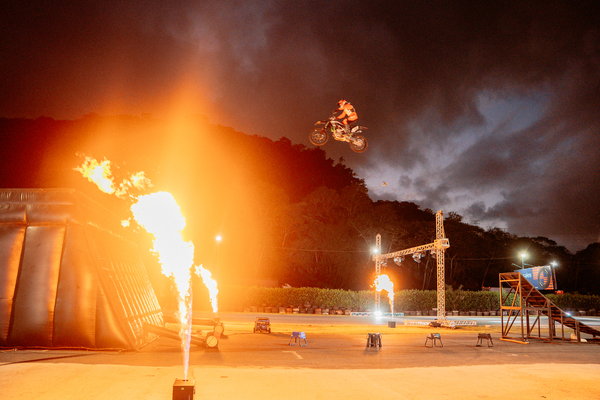
The tire smoke, the car lights, the spotlights, the fire, and the neon effects created an almost surreal atmosphere, where motorsport is able, on its own, to create the perfect environment — an environment with no green screens, an environment so real that even if filmed with a phone, anyone watching would be impressed. So doing that and filming with top-tier equipment, like the very same Porsche Cayenne that filmed Fast and Furious in Brazil, was relatively easy!
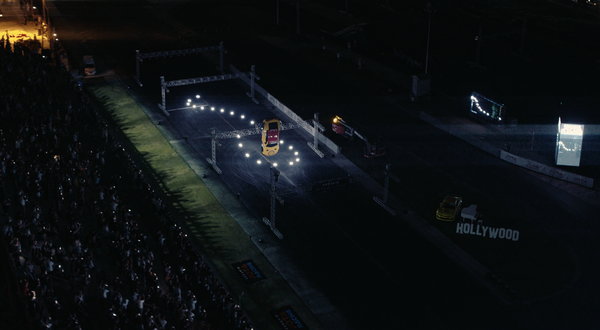
The bigger problem was: one shot! That was extremely stressful and exhausting — the drones had only one window of time during the event to do the live performance for the audience. As a driver myself, I couldn’t get the timing wrong, and the camera crew even less so, because any mistake would mean we’d lose the show and, automatically, the footage!
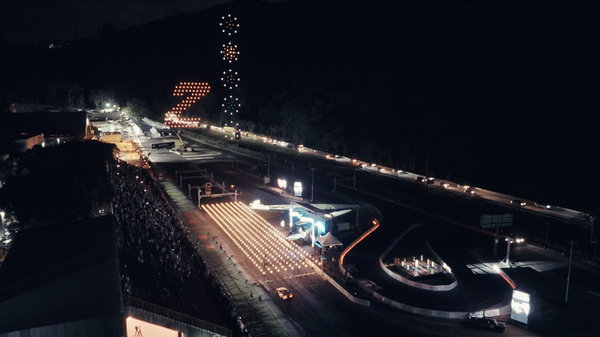
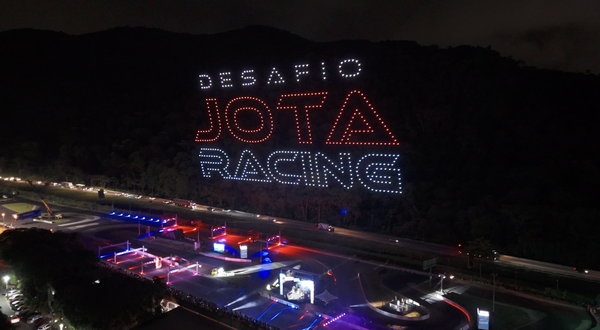
So that was extremely intense, a tense atmosphere, but after everything was executed successfully, the stress turned into emotion over what we had just done — the world’s first filming involving more than 500 drones over a track with a drift car and live visual effects!
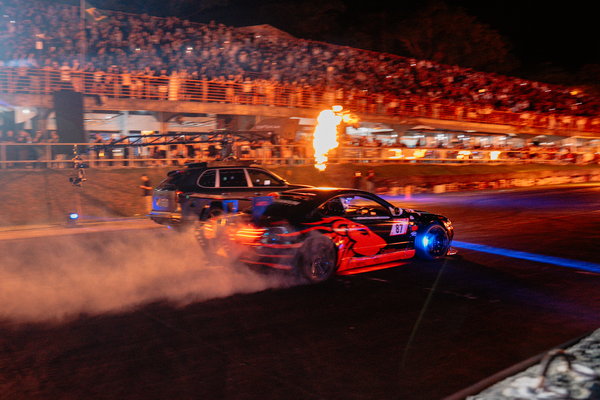
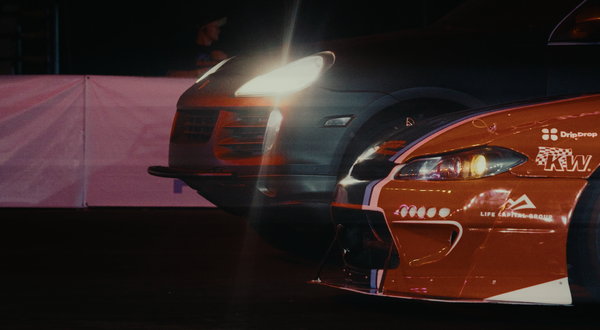
The integration of the drone spectacle — especially the enormous clock and speedometer drawn in the sky — adds a layer of futuristic surrealism to the film. What were the biggest logistical and artistic challenges in synchronizing this technology with the live drift and the musical performance?
It was probably one of the biggest challenges of the entire production.
We needed to synchronize around 500 people working on the event, a gigantic structure, in addition to organizing the driver, the drone team, the special effects team, lighting, cameras, music, and the audience, all happening live, with no margin for error, and, as mentioned above, with only one chance to do it! This was an event, the Desafio Jota Racing, happening live — not a recording where we could do it in parts or redo it in case of a mistake.
But since it was something never done before on a global scale, we knew it wouldn’t be easy!
Artistically, the challenge was even greater: we wanted the technology to have meaning within the narrative. The clock symbolizes time, because every driver knows that every second can change their story. The speedometer with the tachometer represents the passion for speed and the constant pursuit of overcoming limits, linked to the start and the drones following the cars.
These elements helped transform the event into something that goes beyond the sport and enters the world of cinema.
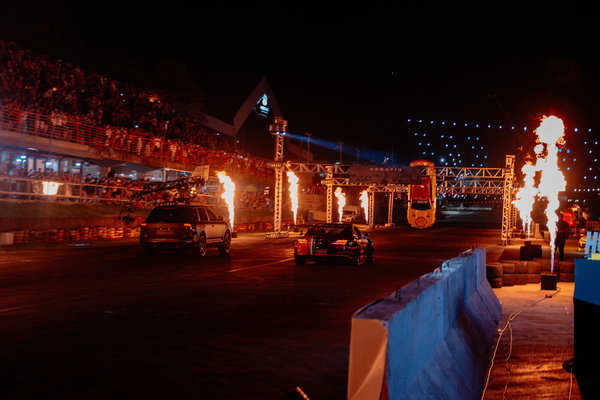
Editing plays a fundamental role in maintaining the adrenaline of the tracks while respecting the rhythm of the music. How did you work the pacing in the editing room to balance the explosive energy of the cars with the singer’s main performance?
We had some challenges — we wanted to make an official music video for the song with footage from the event, at an international standard, to win awards, but at the same time we needed to include footage from various moments of the event, to be able to show the whole picture and not just the drone show. This ends up conflicting during editing and making it harder.
Besides that, because it was one shot, a single attempt, we had a huge amount of footage, so receiving everything and reviewing it all to break it down was another big challenge — a lot of it good, and unfortunately a lot of it useless, but we always preferred to err on the side of excess at that stage.
During editing we tried to think as if we were conducting an orchestra. There are moments when the cars need to be the protagonists, and others when the music takes over that role entirely, others where the audience does, and so we went on — we didn’t want to simply make fast cuts to convey speed.
Every transition was built so that emotion, image, and music would grow together. When everything works in harmony, the viewer stops noticing the editing and simply starts to feel the intensity of the experience.
As creative director, in addition to executive producer and stunt driver on this project, I requested numerous changes until I achieved the result I considered perfect — and when I got there, I was very satisfied with the outcome.
As a filmmaker, you managed to elevate a motorsports event into what the film calls “a spectacle of fire and dreams.” What is the main emotional message you hope the audience — whether passionate motorsport fans or simply lovers of cinema — will take with them after experiencing something so intense?
I hope people understand that Jota Racing Challenge was never just about cars.
It’s a story about people who decided to believe in something greater than themselves. About men and women who face their fears, dedicate years of their lives to self-improvement, and keep accelerating even when everything seems impossible.
The fire represents the passion that drives us. The smoke represents the challenges we face along the journey. And the dreams represent what makes us keep moving forward, which I consider to be the main fuel in my life.
If, by the end of the film, someone leaves believing a little more in their own dreams, then we will have achieved our true goal. After all, more than showing speed, we wanted to show that the courage to pursue a dream can be the greatest achievement of all.
What is your vision of post-COVID cinema?
The pandemic profoundly changed the way we experience entertainment. I believe audiences now value authentic stories and productions capable of creating genuine emotional connections more than ever before.
At the same time, technology has made filmmaking much more accessible for independent creators. Today, it is possible to produce high-quality films with smaller teams, reach international film festivals, and connect directly with audiences through digital platforms.
I believe the future of cinema will become increasingly diverse. While major studios will continue producing large-scale blockbusters, independent filmmakers will play an increasingly important role by bringing original stories and unique perspectives to audiences around the world.
I also believe that artificial intelligence will become one of the greatest transformations in the film industry. It will enable independent filmmakers to create productions with higher quality and significantly lower budgets, democratizing filmmaking and opening opportunities for a new generation of storytellers.
For me, cinema will always remain one of humanity’s most powerful ways of connecting people through emotion.
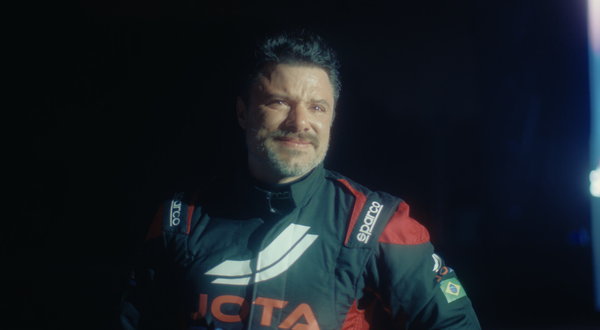
BIO
Biography of Jonathan Neves
“Jota Racing Challenge was never just about cars.”
My name is Jonathan Fernando Cristovão Neves. I am a Brazilian entrepreneur, professional drift driver, executive producer, writer, and creative director.
For more than two decades, I have balanced my business career with my passion for motorsports. In 2014, I had the honor of becoming Brazil’s first Drift Champion, and later I represented Brazil in the world’s leading drift competitions. In 2016, I finished among the world’s top six drift drivers, competing against more than 200 drivers in the only Drift World Championship ever held, with rounds taking place in Japan, Thailand, Europe, Dubai, and other countries.
Driven by my passion for motorsports and filmmaking, I founded Jota Racing Challenge, a project that combines sports, entertainment, and cinema. Through this project, I have transformed my passion for automotive action into cinematic productions while also creating large-scale live entertainment experiences.
One of the greatest milestones of my career was producing the Jota Racing Challenge, recognized as the largest motorsports show ever held in Latin America. The event brought together more than 5,000 spectators, generated over R$5 million in economic impact for the local community, and featured an unprecedented combination of motorsports, live music, pyrotechnics, drones, and cinematic production.
One of the productions I am most proud of is a drift police chase filmed on the legendary Serra do Rio do Rastro, one of the world’s most challenging and iconic mountain roads. We used real helicopters for the aerial cinematography at a time when drones were not yet being used in productions of this scale.
I also produced a project in partnership with NASCAR Brasil, which was nominated for the International Motor Film Awards, one of the world’s most prestigious awards dedicated to automotive filmmaking.
My latest production, Jota Racing Challenge – Official Music Video, features a groundbreaking sequence using more than 500 drones flying alongside a drifting car, combining cinematic photography, visual effects, and spectacular pyrotechnic performances for the event’s official soundtrack. The production has been officially selected and awarded at film festivals across the United States, France, the United Kingdom, Italy, Greece, and several other countries.
Today, I continue writing books while developing film projects focused on stories of perseverance, faith, family, motorsports, and, above all, high-action entertainment. Among my books, the one that holds the most special place in my heart is One-Way Ticket (Passagem Só de Ida), which has sold thousands of copies in Brazil, sharing a story of perseverance and transformation with readers across the country.
Filmography
Jota Racing Challenge – Official Music Video (2026) — Writer, Creative Director, Executive Producer, and Stunt Performer.
Descontrole (in production) — Executive Producer, Actor, and Stunt Performer.
NASCAR at Jota Racing Challenge (2023) — Executive Producer, Actor, and Stunt Performer.
Drift Police vs. Street Drifter (2014) — Director, Executive Producer, Actor, and Stunt Performer.
Various institutional and audiovisual productions related to Jota Racing Challenge.
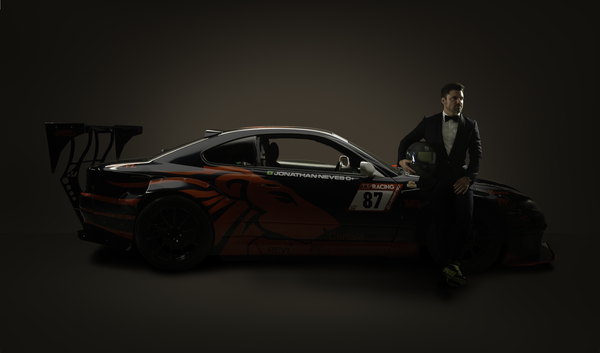
Official links
Official website: desafiojotaracing.com.br
Book website: passagemsodeida.com.br
Instagram: @jjdriftsc
YouTube: Jonathan Neves JJ – JJDriftsc
Interview: Isabelle Rouault-Röhlich

