


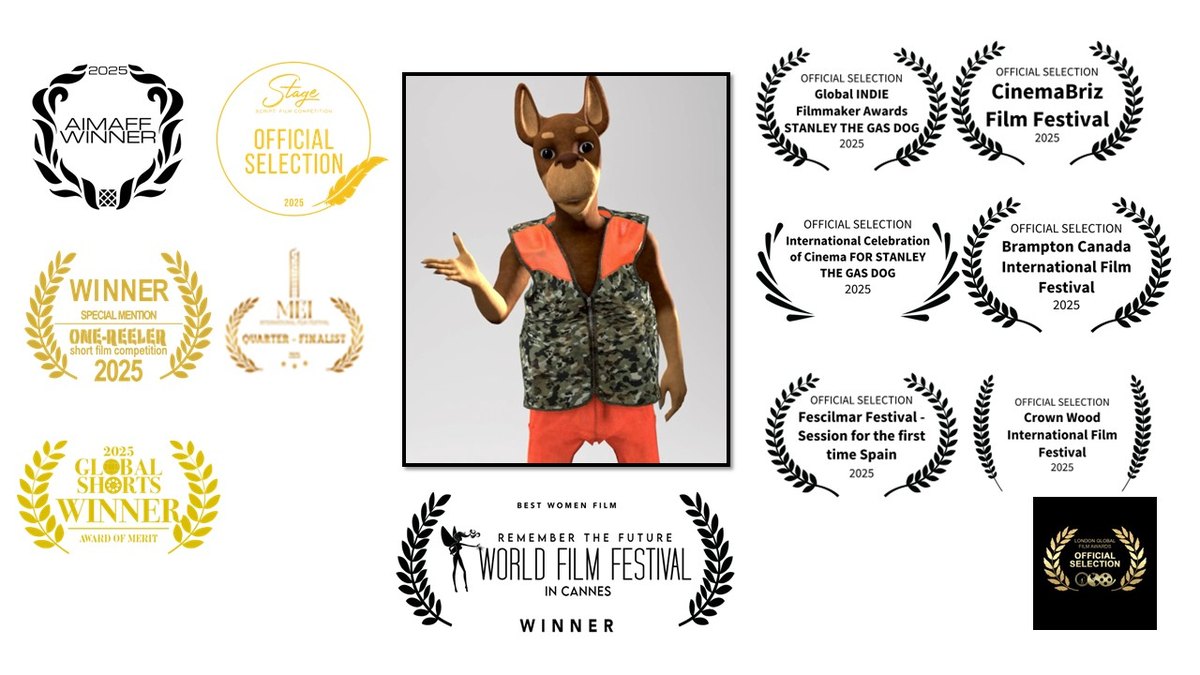
Awarded at the World Film Festival in Cannes during the October 2025 edition with the Best Women Film award, Stanley the Gas Dog is an animated short by British filmmaker Sally Dora Clack-Manning, whose hero, born as the mascot of her family’s heating company, does exactly as he pleases. A conversation.
Sally Dora Clack-Manning, congratulations on your short — it’s amazing, very entertaining and incredibly funny. Any comments on being awarded at the World Film Festival in Cannes?
Being awarded at the World Film Festival in Cannes feels surreal in the best possible way. Stanley the Gas Dog started as a tiny, cheeky idea on my animation computer, and suddenly he’s strutting around Cannes like he owns the Croisette. For an indie filmmaker, recognition at this level isn’t just flattering — it’s fuel. It tells me the humour, the timing, the absurdity, the heart… it all connected. And that’s the dream.
Tell us more about this gas boiler idea?
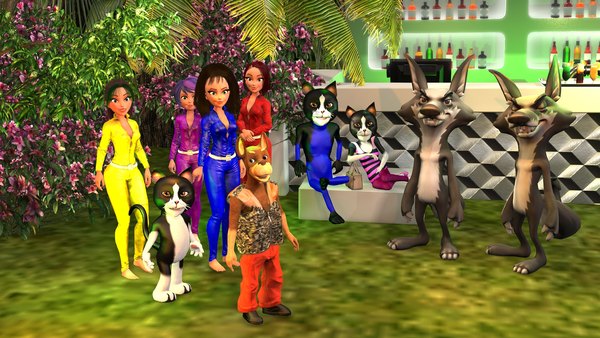
The gas boiler idea began in the most glamorous way possible — I was testing audio levels for my feature film Adventures of Joe Red. Very Cannes, I know. I glanced over at our family company, Master Heating Services Ltd, and thought, “Right then… let’s give the heating world a mascot.”
I didn’t want to borrow anyone from the Joe Red cast — they’re busy saving the world — so I created a new character: Stanley the Gas Dog, the slightly chaotic brother of Ronnie. And from the moment he appeared on my screen, he started bossing me about. Stanley doesn’t act in scenes; he dictates them. I just try to keep up.
Did you use an imaginary location? Were you inspired by the Union Canal by any chance?! And why the choice of DJ Smith & Wesson for a character name?
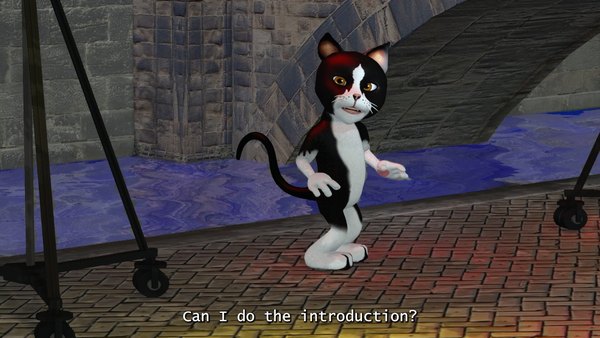
The location is completely imaginary — but I wanted it to feel posh, over-the-top, and a little bit ridiculous. The idea of him arriving on a boat with dancing girls just made me laugh. It’s that perfect blend of glamour and nonsense that animation lets you get away with.
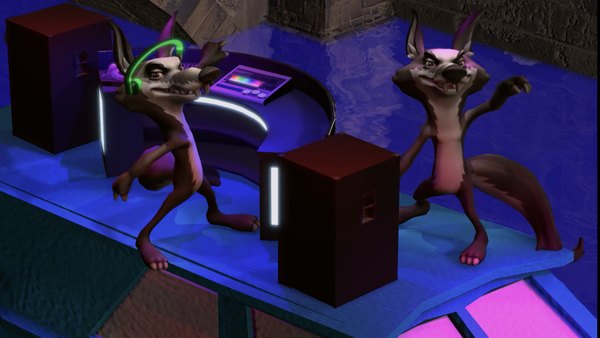
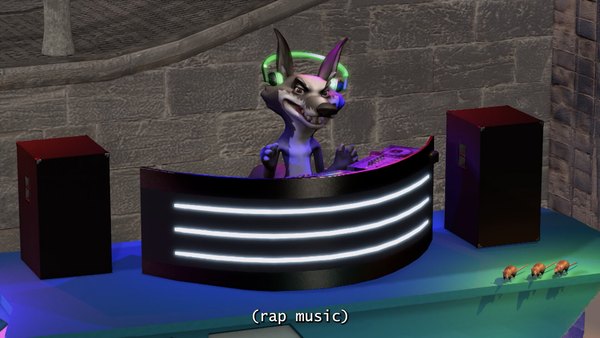
As for DJ Smith & Wesson, the name still makes me giggle. The coyotos in my universe have this slightly gangster, slightly unhinged energy, so giving them names inspired by famous guns felt deliciously ironic. Especially the unseen boat captain, Purdy — he’s a whole character in my head even though you never actually see him.
And one of the moments that cracks me up the most is when the coyotos warn each other not to eat the cat unless he doesn’t pay the bill. It’s so daft, so deadpan, and so perfectly them. I can picture the whole crew on an Ibiza stage with a full crowd, dancing like they own the island. That dance sequence is honestly one of my favourite animation moments I’ve ever created.
A modern ballet was performed at Paris’ Théâtre de la Ville recently called In the Brain by Shechter II, a junior company that renews itself every other year. The theme was “What goes on inside the head of young revellers? Is time suspended? Are they dreaming a dream where people connect to each other, do they feel a sense of belonging to a collective culture? And if so, is clubbing the new ‘folklore’?” What do you think?
This production stirs something deep in me — a reminder of how liberating it is to surrender to rhythm, to movement, to the pulse of life itself. Their work feels like standing at the edge of the sea: you hear the waves before you see them, you feel the beat before you understand it.
It invites you to breathe differently, to taste the music in the air, to let the body remember what the mind forgets. There is a dreamlike suspension in it — a place where time loosens its grip and the spirit begins to wander freely.
For me, it becomes a meditation on calmness over chaos, on choosing flow instead of friction. It whispers that creativity is not something you force; it’s something you allow. And when you allow it fully, your inner spirit doesn’t just move — it runs wild, powerful and untamed, like a stallion released into open space.
If you had a magic wand, what would you want to see in cinema? And what would you change in 2026? Feel free to answer however you like!
If I had a magic wand, I would wish for cinema to return to its purest instinct — to feel a situation rather than calculate it. When I’m creating Adventures of Joe Red, you can honour the commercial world, of course, but still let your mind run with chaos — let the characters talk to you, guide you, misbehave, and surprise you. That’s where the magic lives.
I want to feel the plot in my bones, to sense what the characters love, hate, fear, and desire. I want to breathe the air of the universe I’m building. And at the same time, I absolutely respect the craft. I believe in structure — in plot points, turning moments, the spine that holds the wildness together. Structure is important; it’s the frame that allows the stallion to run without losing its way.
In 2026, I want more films that dare to be unpredictable while still honouring the craft. I want cinema that embraces the beautiful disorder of life, that makes audiences whisper “wow,” or sit in stunned silence because they’ve just felt something they can’t quite name.
If I could change anything, it would be to encourage filmmakers to trust their instincts — to follow the pulse of a moment, to let stories breathe, to let characters lead, to let creativity run free. Because when cinema is brave, audiences feel brave too.
What is the importance of music in film?
Music is the secret soul of a film. It slips beneath the dialogue, beneath the plot, and speaks directly to the places inside us that words can’t reach. It shapes the emotional weather of a scene — the light, the shadow, the ache, the hope.
As I compose the new track for Adventures of Joe Red, I feel my late mother in every note. Music becomes a time capsule in moments like this — a place where memory, grief, love, and longing settle quietly into the melody. You don’t choose what enters the music; it arrives on its own, like small fragments of your heart drifting into the score.
That’s the beauty of film music: it carries the truth of how you feel, even when you can’t say it out loud.
Tell us about your upcoming documentary projects. Tell us everything.
While I have documentary ideas waiting in the wings, the truth is that my heart, my energy, and my creative fire are all focused on one thing: Adventures of Joe Red. This is not just a film — it’s a full-scale universe, a franchise with the scope and confidence of a global American-British hybrid. It carries the emotional depth of European storytelling with the boldness and commercial instinct of American cinema.
Joe Red is our underdog hero; Robot Jane is our breakout mascot; Stanley the Gas Dog is our lovable wildcard; and the mythology — from Gemini to the Crowns to the Sun Burp — gives the world a depth that broadcasters can build on for years.
We believe this franchise will break over $700 million in global sales, not as a dream, but as a realistic commercial trajectory. The world is hungry for new IP, new heroes, new universes — and Joe Red delivers all of that with heart, humour, chaos, and originality.
What makes this project powerful is the way it blends instinct and structure. I feel the story, I feel the characters, I let them talk to me — but I also honour the craft, the plot points, the spine that holds the chaos together. It’s a cinematic language that resonates on both sides of the Atlantic.
The franchise pipeline is already alive: sequels, a bedtime-story app, music, festival-ready shorts, and a world that expands far beyond the first film. This is a universe designed to travel — from London to Los Angeles, from Cannes to New York.
So while documentaries may come later, Joe Red is the flagship. It’s the project that defines this chapter of my career, the one that carries my voice, my heritage, and my belief that independent animation can stand shoulder-to-shoulder with the giants.
What is your vision of post-Covid cinema?
Covid changed everything — not just for the industry, but for me personally. I had Gatwick Gangsters 2 ready to go into production, but I could see the storm coming: actors unavailable, locations shutting down, filming restrictions tightening. The whole live-action machine was grinding to a halt.
So I pivoted. I moved into animation.
Post-Covid cinema, for me, is about resilience and reinvention. It’s about creators finding new ways to tell stories when the old ways collapse. Animation became my lifeline — a space where nothing could stop me. No lockdowns, no travel bans, no closed sets. Just pure creativity, pure freedom, pure storytelling.
That shift didn’t just save a project — it opened a universe. Adventures of Joe Red was born from that moment. A world I could build without limits, a world that could grow into a franchise, a world that could travel globally even when the real world stood still.
Post-Covid cinema is exactly that: a reminder that when the world closes its doors, creativity opens new ones.
BIO
Biography of Sally Dora Clack-Manning
“When cinema is brave, audiences feel brave too.”
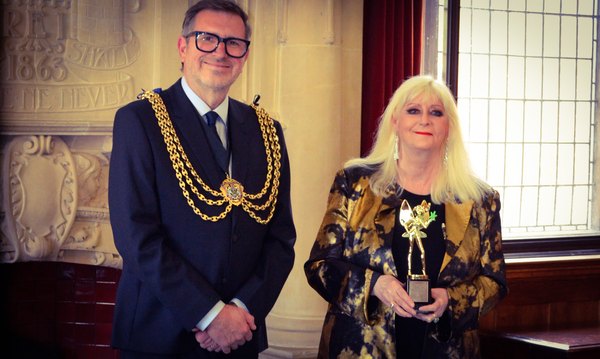
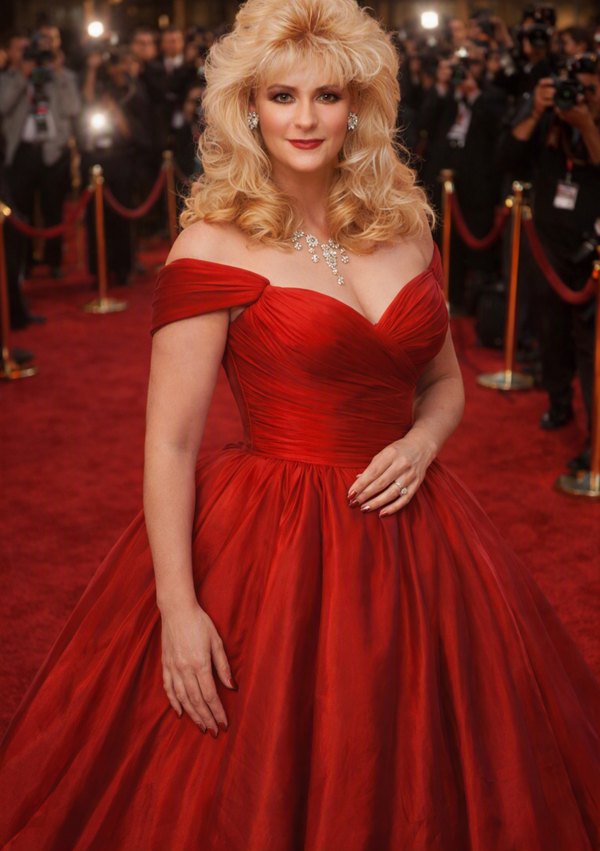
Sally Dora Clack-Manning (artist name: Shampagne) is an award-winning filmmaker, writer, animator, and founder of Master Animations Movies, based in Surrey, UK. Her work lives where grit meets glitter — blending bold visual design, character-driven comedy, and emotionally honest storytelling across animation, music video, and British gangster cinema.
Since 2025, Sally has earned 29 festival wins across three projects:
• Stanley the Gas Dog — a high-energy animated short showcasing comic timing and commercial appeal.
• Losing Ace (Remix) — a neon-soaked rap narrative co-directed with David Manning, rooted in lived experience and social impact.
• Gatwick Gangsters — a stylised British gangster feature written, directed, and led by Sally, released in six languages.
She now announces Adventures of Joe Red, her first feature-length animated film — a family-friendly adventure that pairs spontaneous humour with emotional truth and cinematic scale. Still in production, the film represents a major leap forward for the studio’s creative and technical ambitions.
Before filmmaking, Sally was a top-ranked independent stockbroker, a background that fuels her strategic approach to production, distribution, and world-building. She is currently seeking distribution partners, co-production opportunities, and animation collaborators for upcoming series and feature projects.
Interview : Isabelle Rouault-Röhlich

