



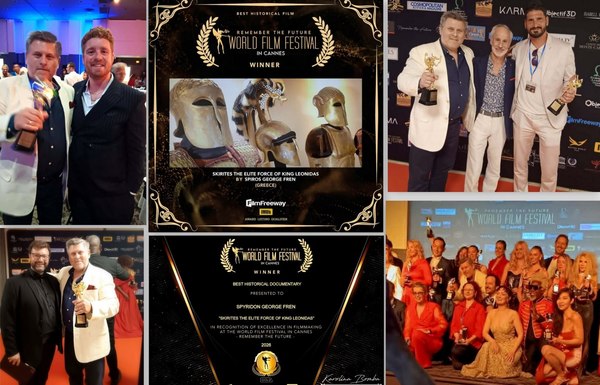
Awarded at the World Film Festival in Cannes during the 2026 Gala with the Best Historical Film award, Skirites the Elite Force of King Leonidas is Spiros George Fren’s documentary devoted to a Spartan commando raid that remained in the shadow of the Battle of Thermopylae. An interview.
Spiros George Fren, welcome to the World Film Festival in Cannes interviews. Thank you for talking to us! First of all, we are keen to ask you: why this documentary subject? Do tell us more, please.
Thank you very much. I am also deeply honored by the opportunity you are giving me to share this interview with you, especially after receiving the great award at the World Film Festival in Cannes, a festival that brings together creators from all over the world.
A heartfelt thank you as well to Karolina Bomba, her team, and the jury for giving me and my collaborators the opportunity to turn our dream into reality. Cannes is, after all, synonymous with the word “dream” for every creator, artist, director, and producer.
I will now answer your first question.
I chose this subject because it concerns a unique event that, for many years, remained in the shadow of the history of my country, Greece, but also in the shadow of the broader historical record of the world.
For centuries, it remained in the shadow of the history of the Battle of Thermopylae, with only a few references in today’s social media and elsewhere, but never, until now, as a complete documentary.
For this reason, many people, including educators in Greek schools, were still unaware of it.
And although the outcome of this commando operation was ultimately not successful — the Skirites did not manage to assassinate Xerxes, King of Persia, and thereby change the course of history — it nevertheless remains an extraordinary and astonishing military operation, even by today’s standards.
Moreover, it demonstrates once again that the great strategic vision and ability of King Leonidas were not limited to the battlefield itself, but extended far beyond it.
After being betrayed by Ephialtes, Leonidas would face his fate and, in a sense, “attack” his destiny. He would do so through a strategy, the night commando operation, which would later evolve into one of the most dynamic forms of warfare and one of the most critical elements of military strategy for every army.
For me, it was also a major directorial challenge. Through the corresponding scientific and historical research, I undertook this project with enormous respect, especially by following the guidance of my scientific advisor, archaeologist and historian Spyros Baka.
Our goal was to bring to the screen a truly unique story. However, because we have very few written historical references available to us, this had to be done with great care, attention, and respect for the evidence.
And, judging from the feedback we received from the international scientific community regarding the historical credibility of the documentary and the careful way in which this story was transferred to the screen, I believe that all the effort was truly worthwhile.
At this moment in time, the cinema world is waxing lyrical about Christopher Nolan’s The Odyssey. What is your view on this epic and how Odysseus’s story was adapted? And a more direct question: how important is King Leonidas in the Greek psyche in this day and age?
Now, regarding your second question: is it really true that the public, the audience, the viewers, are the ones who ultimately determine whether a work will be recognized or not? That is certainly true when we are talking about ticket sales and commercial success. But success is a word with many different dimensions.
One of these dimensions, especially when we are talking about The Odyssey and, in general, any major production, is always, first and foremost, the financial parameter. That does not necessarily mean success in itself, but in the hands of a very good filmmaker such as Christopher Nolan, it is certainly important.
From that point onward, however, it is up to the filmmaker to determine how he will bring such a monumental epic to the big screen.
I believe that, although the result reflects a very dynamic approach and, aesthetically, quite a beautiful one, there are nevertheless certain gaps in the way the work’s deep Homeric perspective and Greek identity have been transferred to the screen.
And because I do not exclude myself from such bold approaches and cinematic risks either, I will answer your question directly: I believe that the chemistry between the creator and the history and cultural identity of a country must be deeply connected.
For example, I would never make a documentary about the Samurai, no matter how prestigious or flattering such a proposal might be. Why? Because I simply could not. There is no way I could truly feel or fully understand the depth and cultural significance that this part of history carries, from within the perspective of a Japanese creator.
Yes, I could perceive it, understand it, and even appreciate its magnitude. But I could never truly render it with the same depth. I could never create what I have been able to create with the Skirites, a story that comes from a deep emotional connection, something I feel and coexist with as a small piece of the endless mosaic that constitutes my own Greek cultural identity.
As for King Leonidas, he remains one of the greatest military role models, not only for Greeks but also for many other nations, particularly in the Western world. He makes us feel proud and inspires us to remain true to the values and ideals for which those men sacrificed themselves, for all of us.
It is a relationship that will, after all, resonate throughout eternity. The monument at Thermopylae does not simply record what happened. In essence, its famous inscription captures, in just five lines, an eternal covenant between the Greeks:
“Go, stranger, and tell the Lacedaemonians that here we lie, obedient to their commands.”
Only, in my view, when we read the word “Lacedaemonians,” we should understand it in a much broader and timeless sense. We should see it as referring to all Greeks, and indeed to all peoples who believe in the same ideals and values.
That, for me, is the true significance of King Leonidas for all of us.
1,200 warships, a million infantrymen coming from 46 nations, going into battle knowing the futility of the sacrifice and the inevitable outcome. That gives much food for thought in 2026. Can you tell us when it was established that the Skirites were the very first “special forces” of the Spartan army, as early as 418 BC? What does that tell us in light of today’s world events?
I will begin with a word you used in your question, a word that, on the surface, sounds sad, even tragic. But when you look it straight in the eye, you can transform it into an epic. That word is “futility.”
The reality does indeed give it that tragic dimension: 1,200 warships and almost one million infantry troops. And yet Leonidas looked them straight in the eye with his 300 men and answered with another word: “duty.”
And with that word, he erased futility from the souls of the 300, and he remained.
Even after the betrayal, and despite every circumstance being against him — even with Xerxes himself absent from the scene during the Skirites’ night raid — Leonidas remained.
Duty above futility.
That duty remained, and today the entire world continues to speak of it and draw inspiration from it. Even in defeat, duty became an act, and once and for all it erased futility.
The legacy of this greatness will endure for eternity, because nothing is more important than one’s homeland.
As for the Skirites as the special forces of Sparta, as I mention in my documentary, we do not have an abundance of sources. What we do know for certain comes from ancient Greek texts of the 5th and 4th centuries BC.
Specifically, the historian Thucydides, in his Histories, and the writer and military commander Xenophon, in The Constitution of the Lacedaemonians and the Hellenica, as well as, later, Diodorus Siculus, describe the role of the Skirites as an advance guard and an elite force operating alongside the king.
Diodorus Siculus, in his monumental work the Bibliotheca Historica, refers quite specifically to the role of the Skirites, reinforcing their reputation as an elite force capable of rapid intervention and strike action.
He tells us that the so-called “Skirite” company of the Spartans did not deploy alongside the main army.
Furthermore, according to other historical interpretations of Diodorus’s accounts, during the famous Battle of Thermopylae in 480 BC, the Skirites took part in the daring night raid by the Greeks into the Persian camp itself.
There, showing what we would today describe as commando capabilities, they managed to penetrate deep into the Persian camp, kill two of Xerxes’s brothers, and come very close to the Persian king’s own tent.
Through these accounts, Diodorus makes it clear that the Skirites were not simply ordinary line soldiers, but a flexible elite company, very much comparable, in functional terms, to what we would call commandos today.
They represented the Spartan king’s “last hope,” or “trump card,” when the objective was to alter the course of a battle.
As for what the history of the Skirites can teach us today, I believe that their military and strategic character offers timeless lessons that resonate directly with modern geopolitics and contemporary global conflicts.
The need for flexibility in the face of mass: the Skirites did not prevail through numerical superiority, but through speed, specialized training, and autonomy.
Today, in modern conflicts, large and cumbersome conventional forces increasingly coexist with, and are often complemented by, small, highly mobile commando units, drones, and special forces.
The ability to strike an enemy with precision and move rapidly can prove more decisive than the sheer number of soldiers.
Diodorus stresses that the Skirites were sent wherever the battle line was under pressure, in order to shift the balance.
Today, modern defense alliances, such as NATO and European security structures, place enormous emphasis on Very High Readiness Joint Task Forces (VJTF). The ability of a force to deploy within hours to a threatened front can be decisive for deterrence in a crisis.
The Skirites were not Spartan citizens. They were Perioikoi, inhabitants of a mountainous and particularly demanding region, to whom Sparta entrusted a prominent military role.
On today’s geopolitical chessboard, major powers often rely on local, specialized partners who know the terrain intimately and possess strong motivation to defend their own region.
This shows that incorporating local knowledge and regional particularities can prove strategically essential.
And finally, I believe their relationship with Sparta reminds us, in a rather interesting way, of the principle behind Article 5 of the North Atlantic Treaty: collective defense.
An attack against one ally — even against one of the geographically most exposed states on the periphery, such as the Baltic countries — is regarded as an attack against all, triggering the collective response of the Alliance.
In that sense, the story of the Skirites carries a message that remains remarkably relevant today: sometimes, it is not the size of the force that determines the outcome, but its readiness, flexibility, courage, and absolute commitment to its mission.
According to the EBU, you are “one of the best videographers in Europe.” With that in mind, what message would you like to convey to our audience?
Recognition from an organization of the stature and prestige of the EBU is a tremendous honor, but above all, it creates a deep responsibility toward the audience.
As a director and cinematographer, I believe that the camera is not simply a tool for recording reality; it is a bridge to empathy.
I began my career as a news cameraman at ERT. For 25 years, I covered every kind of report and news story, both in Greece and abroad, always with tremendous passion and dedication.
During the last 14 years of my career, I also worked as Director of Photography at ERT, Greece’s national public broadcaster.
The message I want to convey is that, in an era saturated with fleeting images, our responsibility is to search for truth and authenticity in every frame.
Every shot must respect the intelligence of the viewer, tell a story with clarity, and create genuine emotion.
Follow your heart, and believe strongly in what you do.
This distinction, just like the unique recognition I received at the World Film Festival in Cannes (WFF in Cannes), belongs equally to all my collaborators.
Cinema and television are, above all, collective arts. And when everything is created with mutual respect, passion, and love for what we do, the result can become truly magical and can ultimately lead to international recognition.
That, for me, is the greatest reward: not simply to create an image, but to create something together that can travel beyond borders and touch people around the world.
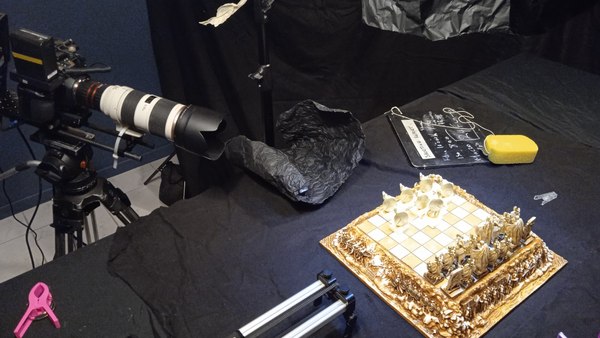
“Two worlds collide: East and West.” This phrase from your documentary is so poignant it deserves a comment. What do you think? And last but not least, if you had a magic wand, what would you conjure up in this world?
The phrase “Two Worlds Collide: East and West” was not chosen randomly for the documentary. My goal as a director was not to record a simple geographical or political confrontation, but rather a deeper, existential struggle that has repeated itself throughout human history.
If we look at the past, from the era of ancient Sparta and the Persian Wars to the geopolitical realignments of our own time, we can see that the challenges may change their face, but fundamental values remain timeless. Freedom, justice, human dignity, and respect for difference are not things we can take for granted. They are values that, just as then, must be protected every single day. History teaches us that when the balance of these values is disturbed, conflict becomes inevitable. The camera, therefore, becomes a tool for reminding the viewer of precisely this responsibility.
Now, as for the “magic wand”… If I had the power to bring something into this world, it would not be a material possession, nor would it be some utopian geopolitical peace imposed from above.
I would create a universal mirror of empathy.
I would create a way for each “world,” whether East or West, to see clearly through the eyes of the other. To understand the other’s fears, hopes, and roots.
We will always be different worlds, for many reasons. But at some point, we must learn to live together in peace, with values and mutual respect.
We must stop letting one person, two people, a handful of people — however many they may be — make decisions on our behalf based on hostility and hatred. We must find the path toward understanding and dialogue, rather than accept that we keep walking down the road of mutual destruction.
As a filmmaker, this is what I try to do with every frame: to break down the walls of prejudice and turn the lens toward our shared human destiny.
If we can learn to see the “other” not as a threat, but as part of the same human story, then perhaps our worlds can stop colliding and finally begin to speak to one another.
Perhaps that is where the real magic lies — not in changing the world with a wave of a wand, but in changing the way we see one another.
If you had a highlighter and an eraser, what would you highlight, and what would you diminish or erase, in your career or your projects?
What a wonderful question, truly…
As human beings, and above all as artists and creators, but also as simple observers of life, of everyday existence, and of everything we ourselves do throughout our journey, we inevitably come back, at some point, to this question:
What would we erase? What would we change? What would we do differently if we could turn back time?
Well, after a great deal of thought and deep personal reflection, if you gave me the opportunity to make that journey back in time, I would tell you with absolute honesty:
I would change nothing.
And certainly not out of arrogance or ego. Quite the opposite. I have made many mistakes in my life.
There were personal failures, difficult moments, decisions I might see differently today, disappointments, and roads that were not always easy to walk.
But if I removed even one piece of all that, perhaps I would not be the person and the creator I am today.
Because life, just like a film, is not made only of beautiful scenes. It is also made of silences, twists, mistakes, dark moments, and difficult shots that often force us to change our perspective, to look at the same frame again, and to discover within it something we had not seen before.
If I had not gone through all those difficulties, personal setbacks, mistakes, and problems, I would never have reached the great successes that came later.
And one of those successes, without a doubt, is the unique experience you offered me through your wonderful World Film Festival in Cannes, the WFF.
That is why, when I look back today, I do not want to erase the difficult moments. I want to keep every one of them.
Because they were also part of the journey.
Perhaps, in the end, life resembles the editing of a film more than anything else. There are scenes you wish you had never filmed. There are others you wish you had lit differently. But when, in the end, you bring all those shots together, you realize that every scene was necessary for the final film to exist.
And this is my film.
With its bright moments and its dark ones, its victories and its defeats, the people who stayed and those who left, its mistakes and its moments of vindication.
And if you ask me today, having the chance to go back in time, what I would change?
Nothing.
Because perhaps even our mistakes are, in the end, part of the road that leads us exactly where we are meant to go.
Can you tell us about your upcoming projects?
My next projects are still in the planning stage. However, I can already tell you that, following our great success at your wonderful festival, I feel that new paths are opening up before us.
The international journey of The Skirites and the recognition the film has received have created new opportunities and, above all, have brought us closer to people from the business world who have seen, understood, and appreciated both the work itself and its remarkable journey. Today, I am fortunate to have sponsors and partners from different areas of business by my side, people who believe in taking the next step and want to take it together with us.
And that next step is a dream I have carried for many years: a beautiful and ambitious documentary about Alexander the Great.
So, our next cinematic journey, if everything unfolds as we have planned, will take us to Macedonia, to the land of the great military leader Alexander the Great — to the land where Alexander was born and raised.
I sincerely hope that my strong and dedicated team and I will be able to create a documentary unlike anything made before. We want to tell this story through the same cinematic language we followed for The Skirites: with powerful imagery, emotion, research, and historical reenactments, but above all with love, respect, and passion for history.
Because this is the way I know how to create. I do not simply want to present History. I want the audience to feel that they are travelling through it.
And it is precisely this way of creating — with passion, authenticity, and love for the subject — that led us to our great success with The Skirites.
And if everything comes together as we dream it will, and as it should, then I believe it will not be long before we meet again.
Perhaps once again in Cannes.

What is your vision for post-Covid cinema?
After the COVID-19 pandemic, humanity as a whole went through one of its greatest challenges. We suffered, but we endured. We emerged with scars, yet those scars will forever remind us that when we stand together, we are capable of achieving extraordinary things and overcoming even the greatest hardships.
Cinema, the arts, and culture were not left untouched. Our own film experienced incredible delays and countless obstacles before it was finally completed and had the honor of reaching your wonderful festival.
And yet, we succeeded.
Culture is humanity itself. Its destiny is to remain standing, regardless of the difficulties or adversities it faces. That is also my answer to your question.
My vision for the post-COVID era is one of optimism and determination. I believe we will move forward with even greater strength. We will give everything we experienced the seriousness it deserves, learn from those difficult times, and be better prepared for whatever challenges the future may bring.
As long as there are inspiring personalities like Ms. Karolina Bomba, our confidence in the future of cinema and culture grows even stronger.
By bringing together outstanding filmmakers from around the world through the remarkable festival she envisioned and created, she has built a unique platform that inspires creativity, encourages artistic excellence, and fosters cultural exchange across continents.
On behalf of myself and my entire production team, I would like to express our sincere gratitude to Ms. Karolina Bomba for the great honor of being part of such a prestigious event as the World Film Festival in Cannes, and especially for naming our film a Winner. It is a distinction we will always cherish, and we are deeply grateful for this unforgettable recognition.
BIO
Biography of Spiros George Fren
“Cannes is, after all, synonymous with the word ‘dream’ for every creator, artist, director, and producer.”
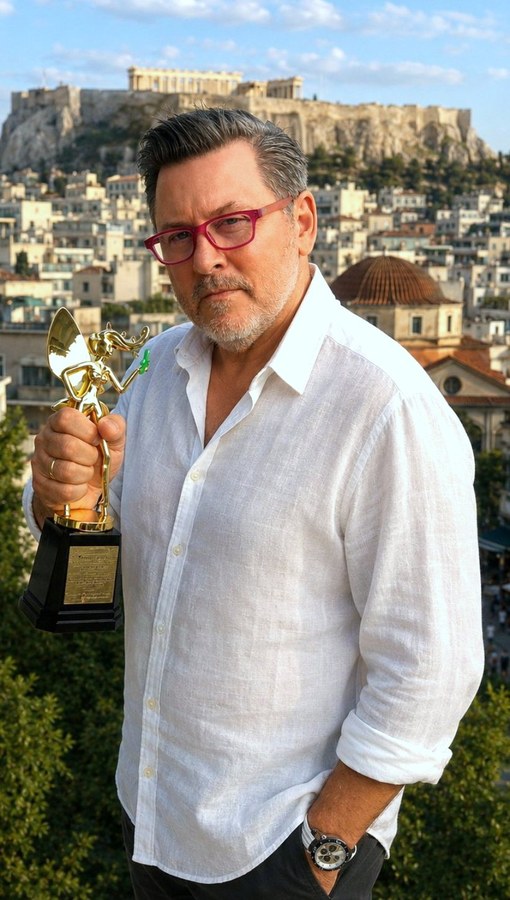
Spiros George Fren is a Greek film director, editor, cinematographer, and camera operator with more than 37 years of experience at ERT, the Hellenic Broadcasting Corporation. A graduate of the L. Stavrakos Film Academy in Athens, he has worked as Director of Photography and as an ENG and studio cameraman, while also leading ERT’s mobile news units.
Throughout his career, he has covered major political summits, international conflicts, breaking news events, and several Olympic Games. His work has taken him to war zones in Iraq, Kuwait, Albania, Israel, and the West Bank, as well as to major sporting and cultural events including the Olympic Games, UEFA Euro 2004, and the Eurovision Song Contest.
He has collaborated with international broadcasters such as the BBC, CNN, ZDF, RAI, TVE, and the EBU, and has filmed prominent political leaders, filmmakers, artists, and musicians. His documentary and cinematography work has received several distinctions in Greece, notably for the acclaimed series Sports Stories.
Alongside directing and cinematography, he is experienced in video editing, lighting, drone operation, and Jimmy Jib camera work. His career is defined by a strong visual sensibility, extensive international experience, and the ability to work in demanding, high-pressure environments.
Interview: Isabelle Rouault-Röhlich

